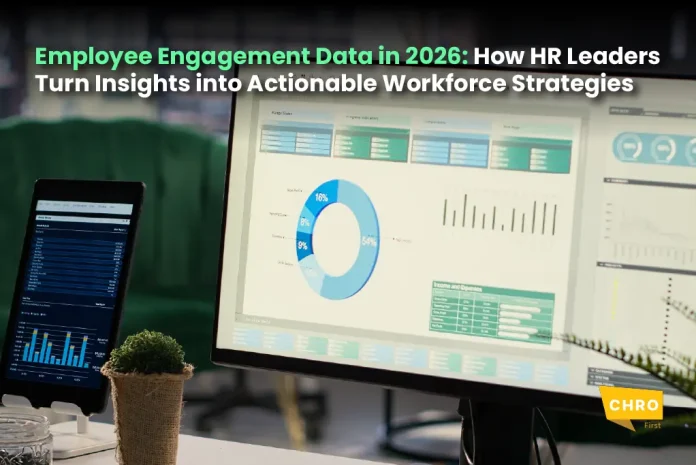
Employee engagement used to be a quarterly ritual. A survey goes out, scores come in, leadership nods, and nothing really changes. That model is done.
In 2026, employee engagement data behaves less like a feedback tool and more like a financial ledger. It tracks movement, signals risk, and quietly predicts outcomes before they show up on attrition reports. The shift is clear. Organizations are moving from reactive pulse checks to predictive workforce intelligence that actually influences decisions.
McKinsey & Company demonstrates this change through its direct evidence. The State of Organizations report for 2026 identifies artificial intelligence and data analytics alongside other forces that currently reshape companies, which include employee expectation changes and productivity and long-term impact, which organizations aim to achieve.
That changes the role of HR. Collecting data is no longer enough. Modeling outcomes is the real game. This is what defines the Workplace Intelligence era.
The 2026 Data Landscape Beyond Sentiment Scores
Most organizations still believe they understand engagement because they run surveys. The problem is not effort. It is timing.
Surveys capture how people felt last week. Engagement problems build in real time.
This is where employee engagement data has evolved. It now pulls from two streams. Active data and passive data. Active data includes surveys and feedback forms. Passive data comes from how work actually happens. Communication patterns, meeting loads, collaboration networks, response times. This is where Organizational Network Analysis starts to matter. Not who reports to whom, but who actually works with whom.
The gap between perception and reality becomes obvious when behavior is measured.
Microsoft makes that gap impossible to ignore. Its 2025 Work Trend Index says employees are interrupted every two minutes, which adds up to 275 interruptions a day, and 48 percent of employees say work feels chaotic and fragmented.
That is not an engagement score. That is a system failure.
Now layer AI on top of this. Natural Language Processing is quietly reading patterns across internal communication tools. It is not reading content for control. It is identifying signals. Drop in participation. Change in tone. Reduced collaboration. These are early indicators of burnout or disengagement, long before an employee checks a box on a survey.
So the question shifts. Not how engaged are employees. But what signals show they are about to disengage.
This is why workforce analytics strategy in 2026 is less about dashboards and more about detection. Engagement is no longer reported. It is inferred.
Turning Insights into Action Through Predictive Retention
Data without action is decoration. Most organizations are still decorating.
The real shift in employee engagement data is happening in how it is used to predict behavior. Not just explain it.
Predictive retention models are built on a simple idea. Patterns repeat. If you can identify the signals that preceded past exits, you can spot the next ones early. That is where the flight risk algorithm comes in. It does not rely on one metric. It looks at a mix. Reduced collaboration, lower participation in key projects, increased after-hours work, fewer interactions with managers. None of these alone matter. Together, they tell a story.
This is where many leaders get uncomfortable. Because the biggest variable in engagement is not perks or policies. It is the manager.
Data consistently shows that managers drive the majority of engagement variance. Which means predictive models often highlight not just who might leave, but where leadership gaps exist.
Now add another layer to this.
OpenAI shows how fast workplace behavior is changing. Its enterprise AI report says weekly ChatGPT Enterprise messages increased roughly 8 times over the past year. The average worker is sending 30 percent more messages. Projects and Custom GPTs are up 19 times year to date, and frontier workers send 6 times more messages than the median employee.
This is not just adoption. This is a data explosion.
Every interaction creates digital exhaust. Every prompt, response, and workflow leaves behind behavioral signals. That data feeds predictive models. It strengthens accuracy. It reduces guesswork.
So the shift becomes clear. Stop asking employees how they feel. Start analyzing how they work.
Engagement scores look backward. Retention probability looks forward.
Meaningful Workplace Experiences Through Personalization at Scale
One-size-fits-all engagement strategies are quietly failing. Not loudly. Just consistently.
Different employees want different things. A Gen Z employee might prioritize purpose and growth. A Gen X employee might value autonomy and stability. Treating them the same does not create fairness. It creates friction.
This is where employee engagement data starts shaping Employee Value Propositions at an individual level. Not segments. Individuals.
Hyper-personalization sounds complex, but the logic is simple. Use data to understand what matters to each employee. Then align work, growth, and rewards accordingly.
This is also where the career ladder starts breaking. Linear growth paths do not match modern expectations. Instead, organizations are building growth lattices. Lateral moves, project-based roles, skill-based mobility. All driven by workforce analytics.
But here is the reality check.
Deloitte points out the gap clearly. The 2026 Global Human Capital Trends study found that only 8 percent of organizations successfully meet their continuous learning requirements. The study shows that organizations which create new job functions and work processes for human-AI partnerships achieve better outcomes than their financial investments while providing substantial employment options.
So the opportunity is not hidden. It is just underutilized.
Personalization is not about offering more benefits. It is about designing better work.
When employee experience analytics connects with internal mobility data, engagement stops being an initiative. It becomes a system.
Also Read: HR Automation Software in 2026: How Intelligent Tools Are Streamlining HR Operations and Driving Efficiency
The Ethics of Intelligence and the Need for Transparency
More data creates more power. It also creates more risk.
Employees are not unaware of this shift. They see the tools. They feel the monitoring, even when it is indirect. That creates a trust gap.
Only a small percentage of employees feel informed about how AI uses their data. That gap is not technical. It is communication.
At the same time, adoption is already high.
PwC reports that 54 percent of workers used AI in the last 12 months and 14 percent use GenAI tools daily at work.
So the contradiction becomes obvious. Employees are using AI tools every day. But they do not fully understand how their own data is being used.
This is where organizations need to slow down and get one thing right. Transparency.
Employee engagement data should inform decisions, not replace them. Human judgment still matters. Context still matters. Numbers without interpretation can easily mislead.
This is why the human in the loop is not optional. It is necessary.
Regulations like GDPR and local data protection laws are not just compliance frameworks. They are trust signals. When organizations clearly communicate what data is collected, how it is used, and where the boundaries are, employees respond differently. Data quality improves. Participation improves. Insights become more reliable.
Without trust, even the best analytics fail.
The HR Leader as a Strategic Architect

Employee engagement data is not the solution. It is the tool.
The real shift is in how HR leaders use it. Moving from collecting feedback to designing systems that predict, adapt, and improve continuously.
The future is already visible. Real-time signals. Smarter models. Even early conversations around biometric engagement data are starting to surface. That brings new ethical questions that cannot be ignored.
So the role of HR evolves again. Less operator, more architect.
The next step is simple but uncomfortable. Audit your current stack. Identify what drives outcomes and what only reports activity. Remove the noise.
Because in the end, data can show patterns. But it is empathy that turns those patterns into better decisions.
And that is where real engagement begins.