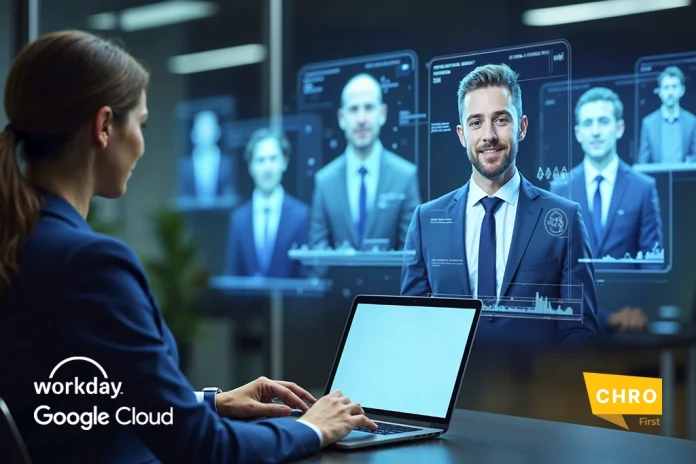
Workday and Google Cloud have announced an expansion of their strategic partnership aimed at integrating AI agents directly into enterprise HR and finance workflows. The collaboration reflects the growing enterprise demand for AI-powered workplace automation as organizations increasingly move toward intelligent operational ecosystems powered by generative and agentic AI technologies.
Under the collaboration, Workday and Google Cloud will use various technologies provided by Google, such as Gemini AI models and Google Workspace applications. It is envisaged that employees will perform HR and finance processes through the use of Gmail, Google Docs, Google Chat, and Google Meet applications. This means that workers will not be forced to jump from one enterprise application to another during their day-to-day activities.
Under the collaboration, AI agents are supposed to assist in the performance of a number of business processes. Some of these include workforce planning, payroll support, recruiting process coordination, employee onboarding, expense tracking, financial analysis, and other operational processes.
This alliance is part of Workday’s overall efforts to enter the realm of agentic AI technology, including its recent efforts to launch products that focus on AI-based workflow orchestration, self-service automation, and intelligent enterprise assistants. Google Cloud, on the other hand, has continued its efforts to develop an enterprise AI ecosystem by using Gemini, among others.
Also Read: Workday Research Finds AI Is Reducing Burnout While Raising Concerns About Workplace Connection
Agentic AI Expanding Across Enterprise Operations
The announcement shines a light on a significant trend shaking up the enterprise software industry: the emergence of AI-native workflows. Early enterprise AI implementations were concentrated mostly on chatbots, content creation, and boosting productivity. But, scholars have uncovered that companies are not only implementing AI assistants that can simply perform tasks but also those that are capable of managing workflows, deriving insights, and automating operational processes.
The partnership between Workday and Google Cloud is an example of how enterprise software vendors are transitioning towards “workflow-integrated AI, ” where AI functionalities are so integrated into the daily working environment that they are indistinguishable from the human activities. It is likely that, in due course, workers will consider their interaction with conversational AIs the normal mode of communication with HR, finance, and other operational systems.
This move also illustrates the rising preference for coherent enterprise ecosystems. Enterprises are in a constant battle with disjointed workflows scattered through various applications and systems. The direct placement of AI agents in work collaboration tools could enable organizations to make operations more straightforward and, at the same time, improve employee satisfaction and work output.
Impact on the HR Industry
For HR industry, the larger alliance reveals the point that workforce management platforms are turning into AI-powered intelligent operational ecosystems. Human resource systems are not just dealing with employee records, payroll, and recruiting management. Quite the contrary, these are AI-enabled platforms that can execute automatically employee support, workforce planning, talent management, and administrative workflow.
AI agents embedded in daily work could drastically enhance employee self-service experiences. Employees might resort more often to conversational interfaces when asking for leave, checking salary details, finishing onboarding steps, getting to know company rules, or getting recommendations for career development, all without contacting HR directly.
This alliance might be a part of the solution for the HR teams to work through the ongoing problems with workforce diversity, employee needs, and efficiency of operations. One option is AI-driven automation, which will decrease repetitive tasks and give time back to the HR staff for major projects like strengthening employee relations, preparing leaders, and planning the workforce.
Simultaneously, increasing incorporation of AI in HR processes is bound to raise industry debates over openness, ethical AI practices, employee privacy, and governance. As HR systems store a lot of sensitive information about the workforce, thorough monitoring and compliance mechanisms will be essential for responsible AI rollouts.
Business Impact and Industry Outlook
Using AI agents to do the work of different office teams could help companies become more productive and efficient in their operations. One of the main reasons why organizations still suffer from inefficiencies is Truth is their main enterprise systems run without being adequately linked to each other while manual processes and repetitive administrative tasks are carried out. The introduction of AI in workflow automation could enable companies to operate their business more smoothly as well as make inter-departmental cooperation more effective.
Besides, it also shows how the use of AI is being limited recorded to the extent of digital workplace transformation strategies. Instead of viewing AI as only one productivity tool, enterprises have begun to consider it as an integral operational layer that can support automation and decision-making over the entire enterprise.
On top of that, with the fast pace of enterprises implementing AI, it is anticipated that the collaboration of cloud service providers and enterprise software vendors will be why that will determine the workplace technology of the future. Those organizations that will manage to create a seamless AI-based operational ecosystem will obtain benefits not only in workforce agility and employee experience but also in long-term business productivity.
The expanded Workday–Google Cloud collaboration ultimately underscores a broader shift toward AI-native enterprise environments where autonomous agents become embedded into the daily flow of work. As businesses continue modernizing operations, AI-powered workflows are likely to become a defining feature of the future digital workplace.

