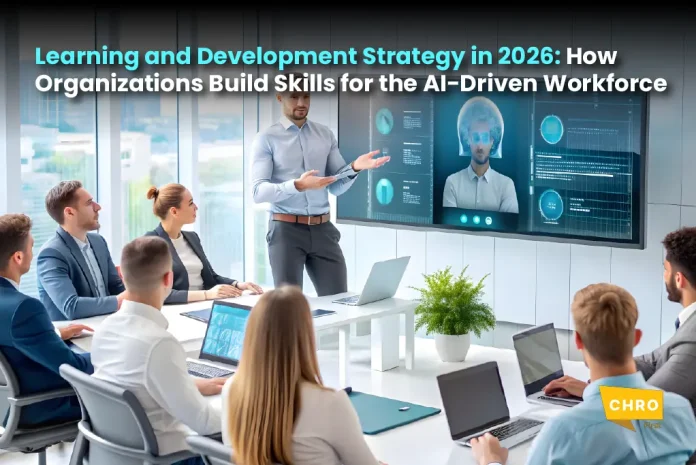
For years, learning and development was kind of treated like maintenance work. Employees showed up for a couple of training sessions, finished the mandatory modules, and then checked yet another box. The whole thing lasted as long as the business could move at a pretty predictable pace. But it does not really survive in 2026.
AI is shifting jobs faster than organizations can even rewrite job descriptions. Skills that mattered yesterday are getting automated, supported, or outright replaced. The real issue is not ‘just’ adopting AI. It’s making sure people can keep up with the pace. That is why a modern learning and development plan is no longer mainly about training delivery, like before. Instead, it’s about building competence in advance, before the business suddenly, and kind of urgently, needs it.
The organizations that are pulling ahead are not always buying more technology. They’re putting in place systems for continuous learning, tailor made development, and ongoing upskilling. In a world where change has become permanent, workforce learning has, quietly but clearly become a competitive advantage.
The Shift to the AI-Driven Workforce and Why Traditional L&D Is Obsolete
Traditional L&D was built for stability. The assumption was simple. Skills changed slowly, employees followed predictable career paths, and training could be rolled out once or twice a year.
That assumption has collapsed.
Most organizations still rely on reactive learning. A skill gap appears. HR notices it. Training gets approved. Courses are assigned. By then, the business is already behind.
The pace of AI adoption explains it pretty much. McKinsey reports AI use at work jumped from 30 percent in 2023 to 76 percent in 2025. Read that again. In just two years, AI went from an emerging workplace tool to something most employees are already using.
But still, a lot of learning programs look like they were designed five years ago.
The real change is that AI is altering learning, like for real. Employees do not really want to sit through generic training that has almost no connection to their day today work. They want answers when problems pop up. They want learning that feels relevant, not just ‘nice.’ They want development to slot into their workflow, and not keep interrupting it.
That is exactly why so many organizations have drifted away from seminar heavy models, and moved toward digital on demand learning ecosystems. Learning is turning less into events and more into access. Less about attendance, and more about building capability.
Also Read: Employee Value Proposition in 2026: How Leading Organizations Attract, Engage, and Retain Top Talent
3 Core Pillars of a Future-Ready Learning and Development Strategy
1. AI-Powered Personalized Learning
One employee wants leadership skills. Another wants to learn prompt engineering. A third needs stronger data literacy. Giving all three the same training plan makes no sense.
Yet that is exactly how many organizations still operate.
AI is helping change this. Modern learning platforms can recommend stuff based on role, skill level, performance data, personal interests, and career ambitions. Instead of pushing the exact same course to everyone, organizations can build learning journeys that feel kind of tailored, and honestly relevant to each employee.
That ‘relevance’ matters because people tend to stick with it more when they can spot a clear tie between what they learn and what they do every day.
And the evidence is already pretty visible. LinkedIn reported that LinkedIn Learning customers were picking up AI skills 3.4 times faster year over year. The takeaway is pretty simple. Employees learn faster when learning feels personal, not generic, not like some remote thing.
A solid learning and development strategy shouldn’t herd employees through identical paths. It should steer people toward the skills that matter most for their future, and not just what happens to be in the catalog.
2. Continuous Upskilling and Reskilling
Many leaders talk about skills development as if it is a project with an end date. It is not.
Upskilling means helping employees improve the skills they already use. Reskilling means preparing them for entirely different responsibilities. Both have become business priorities because job requirements are changing constantly.
The old model relied on occasional workshops and lengthy training programs. The problem is that knowledge fades quickly when it arrives all at once.
Micro learning works better because it mirrors how people actually learn. Small lessons. Frequent practice. Immediate application.
That shift is becoming increasingly important. KPMG found that 87 percent of leaders say upskilling the current workforce is now a key priority.
The interesting part is not the number itself. It is what the number reveals.
Organizations are finally realizing they cannot hire their way out of every skills challenge. Talent shortages are real. Hiring costs are rising. The smartest companies are investing in the people they already have.
3. Cultivating an Agile Learning Culture
Technology helps. Platforms help. Content helps.
Culture decides whether any of it works.
Many companies invest heavily in learning tools only to discover that employees barely use them. The issue is usually not the platform. The issue is that learning still feels separate from work.
People are busy. When learning feels like extra work, it gets pushed aside.
That is why leading organizations are embedding learning right into the day to day, workflow. Employees learn while they’re solving problems with teammates, collaborating, experimenting with new tools, and dealing with those unfamiliar challenges. Kind of it happens as they go, not as a separate step.
Deloitte catches this shift pretty well. The firm says traditional change management and training are just too slow for today pace of change. Instead, AI is helping workers build skills right in the flow of work, you know, like it doesn’t really stall anything. That phrase matters though, because it pushes back on a usual assumption. Learning shouldn’t yank people away from work. It should go through the work, not around it. Full stop.
Organizations that get this tend to create spaces where curiosity, experimentation, and knowledge sharing show up as normal human behavior. Not special campaigns that pop up and then disappear, as if nothing happened.
How to Build Your L&D Strategy Framework for 2026?
Building a future-ready learning and development strategy does not start with buying software. It starts with asking better questions.
1. Conduct a Predictive Skills Gap Analysis
Most organizations focus on current skill gaps. The smarter approach is looking ahead.
What capabilities will the business need one year from now? What about three years from now?
This matters because KPMG found that 62 percent of respondents saw employee skill gaps as a barrier to AI ROI. Companies will often pour a lot into technology, but at the same time under invest in the know how needed to use it in a really useful way, not just on paper.
2. Align Learning Initiatives with Business OKRs
Learning should support business outcomes.
If a company wants faster innovation, learning should support innovation. If leadership wants expansion into new markets, learning should help build the required capabilities.
Training disconnected from business goals quickly becomes background noise.
3. Leverage Modern Learning Experience Platforms
Modern LXPs do much more than host courses.
They bring together learning materials, coaching, teamwork, communities and a little bit of knowledge exchange into one ongoing thing, like a whole experience. Employees can tap into that know-how when it’s actually needed not while they’re waiting around for those planned training sessions.
The goal is not more content. The goal is better learning experiences.
4. Empower Middle Managers
Many learning strategies fail because managers are treated as spectators.
They are not.
Managers influence priorities, coaching, feedback, and development opportunities. When managers actively support learning, participation increases naturally. When they ignore it, even the best learning programs struggle.
A strong learning culture is impossible without strong manager involvement.
Measuring L&D Success Beyond Completion Rates

Completion rates tell you who finished a course. They do not tell you whether anything changed.
That is why organizations are moving beyond activity metrics and focusing on business outcomes.
A stronger measurement framework includes time-to-competency, internal mobility, retention, performance improvements, and productivity gains. These metrics reveal whether learning is actually creating value.
The shift makes sense because business leaders care about outcomes, not attendance.
PwC found that productivity growth is 40 percent higher at companies most exposed to AI than at the least exposed. That insight should challenge how organizations evaluate learning, honestly. Success is not measured by how much content employees consume, or how ‘busy’ they look on paper. Success is measured by how effectively employees apply new skills to create business results, day after day, without so much ceremony.
Investing in the Ultimate Competitive Advantage

Plenty of organizations still treat learning as an HR responsibility. That mindset belongs to another era, really.
The real divide now emerging in business is not between companies that use AI and companies that do not. It’s between companies that can continuously build new skills and companies that cannot.
Technology will keep changing. Roles will keep evolving. Skill requirements will keep shifting. None of that is slowing down.
A strong learning and development strategy is no longer about keeping employees informed. It is about keeping the business relevant. Organizations that build learning into everyday work will adapt faster, innovate faster, and recover faster when disruption arrives.
The uncomfortable truth is simple. The future does not reward organizations that learn eventually. It rewards organizations that learn first.