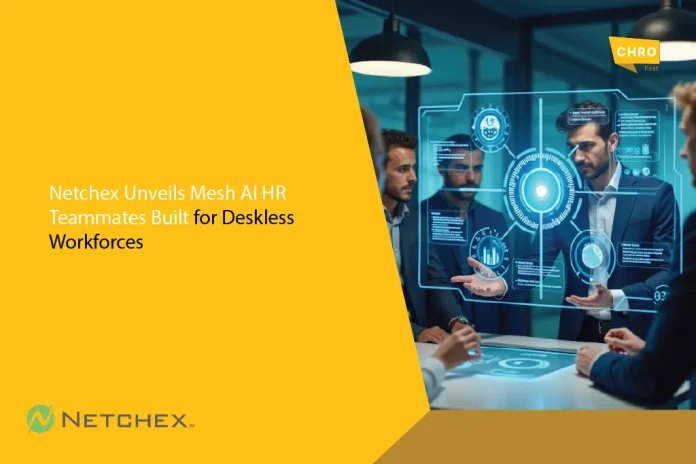
Netchex, a human capital management (HCM) and payroll software provider specializing in deskless workforce operations, introduced Mesh, a dedicated team of autonomous AI HR specialists designed to anticipate operational obstacles and complete complex HR workflows before issues arise. The technological launch marks a shift away from reactive, text-prompt chatbots, establishing proactive AI-driven execution for non-desk enterprise environments.
Unlike standard corporate office environments, deskless industries such as hospitality, dining, automotive dealerships, and outpatient healthcare operate under unique labor constraints where approximately 80% of staff do not sit at computer desks. In these settings, schedule adjustments and shift coverage are often coordinated over informal group chats, while late timecards accumulate. Human resource managers across these businesses frequently operate under tight resource limits, manually balancing payroll processing, timecard reconciliations, leave approvals, and employee onboarding within compressed daily windows.
“Our mission has always been to build the best software and support for deskless industries. AI teammates are how we keep delivering on that, giving every operator the bench strength that used to be reserved for companies ten times their size,” said Abhinav Agrawal, CEO of Netchex.
Also Read: Traliant Study Finds HR AI Adoption Outpacing Governance
Proactive AI Specialists Built for End-to-End HR Execution
Continuous analysis of integrated payroll, scheduling, attendance, and human resources data helps Mesh detect operational friction points. Although humans make the final decisions on important business matters, AI experts operate on their own in terms of managing administrative processes:
Penny (Payroll Assistant): Monitors incomplete time cards, handles payroll problems, and catches hour discrepancies before the issuance of paychecks.
Atlas (People Operations Coordinator): Unites onboarding, employment changes, documentation collecting, and approval routing for workers.
Sentinel (Compliance & Risk Analyst): Monitors operational data constantly to detect trends in risks and compliance problems.
Nova (Workforce Analyst): Unites workforce analytics data and provides operational insights for site managers.
Milo (Employee Concierge): Handles PTO request, shift swapping, paycheck generation, and answers company-related questions.
Nettie (Service Partner): Helps platform admins deal with tech problems and answers their questions based on information from Netchex’s knowledge base.
Because Mesh operates across a consolidated data ecosystem, it identifies cross-departmental connections that isolated tools miss such as detecting schedule overloads that lead to employee turnover or catching expiring technical certifications weeks before they cause staffing shortages. The architecture stems from Netchex’s acquisition of Mesh.ai, a Y Combinator-backed performance and engagement platform, whose founding engineering team led the deployment.
“Operators have been told AI will change everything, but so far it mostly just answers questions when you ask. Mesh gets ahead of the work, handles what people hate doing, and lets them focus on what matters. It can do that because it sees payroll, time, scheduling, and HR as one operation, not different disconnected systems,” said Saurabh Nangia, Chief Product Officer of Netchex & founder of Mesh.ai.
Omni-Channel AI Integration and Enterprise Adoption Trends
Beyond its native platform environment, Mesh integrates directly into everyday communication interfaces. Frontline employees can submit leave requests, request shift coverage, or check pay stubs directly inside third-party LLM applications such as ChatGPT and Claude. Concurrently, managers can evaluate overtime patterns and approve requests, while HR administrators conduct payroll audits without manually logging into the main Netchex system. Explicit human approval protocols remain required before executing sensitive data transactions.
“Our team is small, and we all wear a lot of hats. Having an AI agent continuously checking for errors, handling the prep work, and taking care of routine steps could be a total game changer,” said Tabitha Lehman of Northwest X Southern, a multi-property hotel group and Netchex customer.
Early access deployment data indicates that participating operators reclaim roughly half of their Monday administrative setup hours alongside a double-digit reduction in payroll corrections. The platform rollout coincides with broader enterprise shifts; market research firm Gartner projects that 40% of enterprise applications will embed task-specific AI agents by 2026, up from under 5% in 2025.