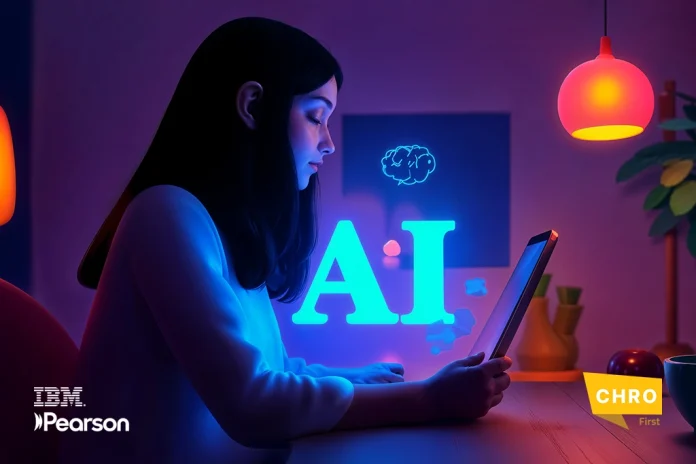
IBM and Pearson, a global company for lifetime learning, have launched a global initiative to develop personalized learning solutions using AI to quickly upskill employees in business and learning institutions in an effort to fill a critical gap in skill levels due to generative AI. The initiative is a response to an increasing need for closing the gap in skill levels due to digital transformations.
As a result of this collaboration, IBM will assist Pearson in creating a personalized learning platform with AI capabilities using ibmwatsonx Orchestrate and ibmwatsonx Governance. The learning platform will make use of AI assistants and AI agents and will have the capabilities of humans enhanced by AI assistance. The technology will benefit people all over the world.
The partnership is also intended to examine technology solutions to confirm AI model capabilities, so companies can safely employ them. As part of the deal, IBM’s current enterprise learning offerings will be incorporated into this new platform. IBM clients and 270,000 employees will benefit when IBM integrates access to learning solutions with additional capabilities in this new platform. IBM’s clients will benefit from learning solutions with enhanced capabilities when this new platform is launched.
IBM CEO Arvind Krishna stated that this collaborative effort will enable learning at a faster pace and learning to adjust to change, and this was echoed by Pearson’s CEO, Omar Abbosh, when he stated learning must become an ingrained part of work because of continuous change.
What This Means for the HR Industry
Closing the Skills Gap with AI-Powered Learning
One of the most common challenges HR executives face in their current state is the skill gap existing within their workforces and the requirements of emerging jobs, which have both been measured in research to cost economies billions every year.
Market Chameleon
The IBM-Pearson venture addresses this challenge directly by offering enterprises a skill gap analysis tool and a learning solution to address these skill deficiencies. Here, the investment in learning is directly linked to organizational requirements.
For HR teams, this will mean that reskilling and upskilling can transition from generic learning modules to a very personalized learning experience, which will help them acquire exactly what they need to do their jobs effectively. Rather than a static learning course, HR can offer AI-driven learning paths based on learners’ progress and evolving business needs.
Integration of Learning into Workplace Activities
This type of collaboration highlights the need for learning in the context of work, a trend in which employees attain new skills in the course of working rather than being drawn out of this work for conventional learning sessions. AI-enabilited learning solutions can assist in identifying relevant courseware, tests, or skill badges at an accurate time to improve learning efficiencies.
Likely, this will lead to an accelerated incorporation of continuous learning culture in companies where employees can upskill in a proactive manner rather than a reactive one, which will be a major competitive tool in today’s rapidly changing market.
Also Read: Udemy and Workera Announce Partnership for Creating “Workforce of the Future” with Skills Intelligence Solution
Enhancing Talent Mobility and Retention
With learning paths, HR leaders can address mobility frameworks within HR, ensuring a smooth transition for employees into different roles without recruitment. This will not only cut recruitment expenditure but also boost retention since employees have a clear progression path in a time when career prospects are a key factor in employee engagement and satisfaction.
Overall Impact on Businesses
Rapid Adaptation to Technological Changes
With industries being revolutionized by AI and automation, companies which implement AI-driven learning solutions will have a competitive advantage in terms of adaptability and resilience. Organizations will improve skill shortages quickly, making it possible for interfunctional teams to adapt to demands in innovation and market dynamics.
Better Competitive Positioning
Those organizations which fill skill gaps in their workforces, especially in AI, cloud technology, data analysis, and digital transformation, will be better placed to innovate and compete effectively. AI-personalized learning at scale will become a factor in attracting and retaining top performers.
Data-Driven Talent Strategy
Integration of learning with AI technology will allow companies to gain better insights into their employee capabilities. Based on learning and skill acquisition, they can arrive at decisions concerning talent management and recruitment.
Conclusion
The IBM & Pearson collaboration is a major breakthrough in the development of learning in the workspace because it brings together the latest AI technology with learning expertise in creating personalized learning solutions for enterprises. As far as the HR sector is concerned, this project brings in a new wave of smarter learning approaches because learning will be optimized to fit business outcomes. Businesses will benefit from this project because it will help them transform and fill skill gaps in a digital economy. With the continued evolution of AI in revolutionizing work, learning tools that enable fast learning will be critical in ensuring that companies remain competitive, thus making this project a great addition to the working world.

